The 2026 Permian Basin Oilfield Delivery Report
How Equipment Delivery Delays Impact Rig Downtime, Operational Costs, and Production Timelines
Published by McLo Hotshot Service LLC · February 2026
Introduction
We analyzed data from 12+ government agencies, industry research firms, and trade sources — including the U.S. Energy Information Administration, Siemens, Baker Hughes, the International Energy Agency, and DAT Freight & Analytics — to answer a question no one in the Permian Basin has quantified before:
How much does a single equipment delivery delay actually cost an oilfield operation?
Specifically, we examined 11 data points spanning oilfield downtime costs, Permian Basin production and drilling activity, emergency delivery pricing, spare parts lead times, non-productive time frequency, and workforce shortages — then connected them to reveal the hidden relationship between last-mile delivery speed and operational losses.
What we found was striking. The Permian Basin produces 45% of all U.S. oil, yet 92% of its facility shutdowns are unplanned. Downtime now costs nearly $500,000 per hour. And an emergency hotshot delivery that could prevent that downtime costs under $2,000.
Below are the key findings from our analysis — along with what they mean for every operations manager, drilling supervisor, and procurement lead working in the Permian Basin today.
Key Findings
- A single emergency hotshot delivery costing under $2,000 can prevent oilfield losses of $500,000 per hour — a 250x return on investment.
- 92% of oil and gas facility shutdowns are unplanned, making rapid equipment delivery a business-critical capability — not a convenience.
- Unplanned downtime now costs oil and gas facilities nearly $500,000 per hour — a figure that has more than doubled since 2022.
- Annual downtime costs per oil and gas facility have reached $149 million — a 76% increase in just two years.
- The Permian Basin produces roughly 45% of all U.S. oil — over 6 million barrels per day — making it the most logistics-dependent oil region in the country.
- Just 10 counties in the Permian Basin are responsible for 93% of all U.S. oil production growth since 2020.
- Permian Basin rig counts have fallen 6.5% year-over-year, yet production continues to rise — shifting logistics demand from new drilling to maintenance and workover operations.
- Equipment moves across the Permian Basin have declined 19% from a year ago, thinning the logistics pipeline even as base production demands constant support.
- Standard oilfield replacement parts carry lead times of 12 to 30 weeks. Legacy components can take up to 12 months — meaning last-mile delivery speed is the only controllable variable.
- A single mid-sized facility logged 39 non-productive time events in one month — more than one per day — at an average cost exceeding $400,000 per incident.
- The trucking industry faces a shortage of more than 60,000 drivers, while over 50% of oil and gas professionals plan to retire within the next decade — compounding the delivery bottleneck at both ends.
Now let’s look at each finding in detail.
1. A $2,000 Delivery That Prevents a $500,000-Per-Hour Loss
Background: When an oilfield operation goes down unexpectedly, the financial impact starts immediately. But when the conversation turns to resolving the problem — getting the right part or piece of equipment to the well site — the focus tends to be on sourcing the part itself, not on how it gets there. Emergency transportation is often treated as a line-item expense rather than a production-saving investment.
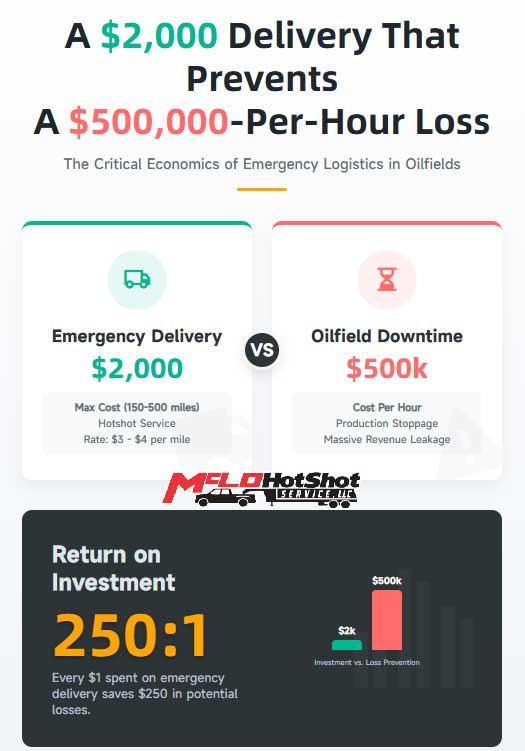
Result: According to current industry rate data from Truckstop, ACV Auctions, and other freight platforms, an emergency hotshot delivery across a typical Permian Basin corridor — roughly 150 to 500 miles — costs between $1,500 and $2,000 at rush rates of $3 to $4 per mile. Meanwhile, Siemens’ 2024 “True Cost of Downtime” research places unplanned oilfield downtime costs at nearly $500,000 per hour. That means a single hotshot delivery represents roughly 0.4% of just one hour of lost production — a return on investment of approximately 250 to 1.
Context: To our knowledge, this is the first published analysis to directly compare emergency delivery costs with hourly oilfield downtime losses for the Permian Basin. The implication is straightforward: delaying a delivery by even a few hours to save on freight costs can result in losses that dwarf the transportation expense by orders of magnitude. For operations managers weighing whether to dispatch an emergency hotshot or wait for a cheaper scheduled option, the math strongly favors speed.
See how McLo has handled time-critical deliveries in the Permian Basin →
2. 92% of Oilfield Shutdowns Are Unplanned
Background: Most oilfield operations maintain some form of preventive maintenance schedule. The assumption is that planned maintenance catches problems before they escalate. But the data tells a different story.
Result: According to research from Kimberlite and Tan Delta Systems, 92% of shutdowns in oil and gas operations are unplanned. That means fewer than 1 in 10 production stoppages occur on a schedule. The rest happen without warning — at 2 a.m. on a Tuesday, during peak production, or in the middle of a completion.
Context: When the vast majority of shutdowns are unplanned, the ability to respond quickly with oilfield equipment transport is not a nice-to-have. It becomes foundational infrastructure. Planned logistics — scheduled LTL shipments, routine freight — can handle the 8% of shutdowns that are anticipated. The other 92% require a different kind of capability: on-call, rapid-response delivery that can dispatch within hours and deliver to a well site the same day or overnight. This is the operational reality that makes hotshot trucking an essential part of the Permian Basin supply chain.
3. Downtime Now Costs $500,000 Per Hour — And It’s Doubled in Two Years
Background: Oilfield downtime has always been expensive. But the pace at which costs have escalated has caught many operators off guard.
Result: According to Siemens’ 2024 industry analysis and supporting data from Energies Media, a single hour of unplanned downtime at an oil and gas facility now costs nearly $500,000. That figure has more than doubled compared to just two years earlier, when the same metric was substantially lower.
Context: Several factors are driving this acceleration. Higher oil prices in 2022–2023 meant that every hour of lost production represented more lost revenue. At the same time, labor costs increased, spare parts became harder to source, and aging infrastructure led to more frequent failures. The compounding effect is significant: downtime is both more frequent and more expensive than it was even recently. For Permian Basin operators running at scale — often managing multiple well sites across Midland, Odessa, and surrounding areas — even a few hours of delay across a handful of sites can translate into millions in losses over a quarter.
4. $149 Million Per Facility: The 76% Surge in Annual Downtime Costs
Background: Hourly downtime costs are alarming on their own. But when aggregated across a full year of operations, the annual picture is even more dramatic.
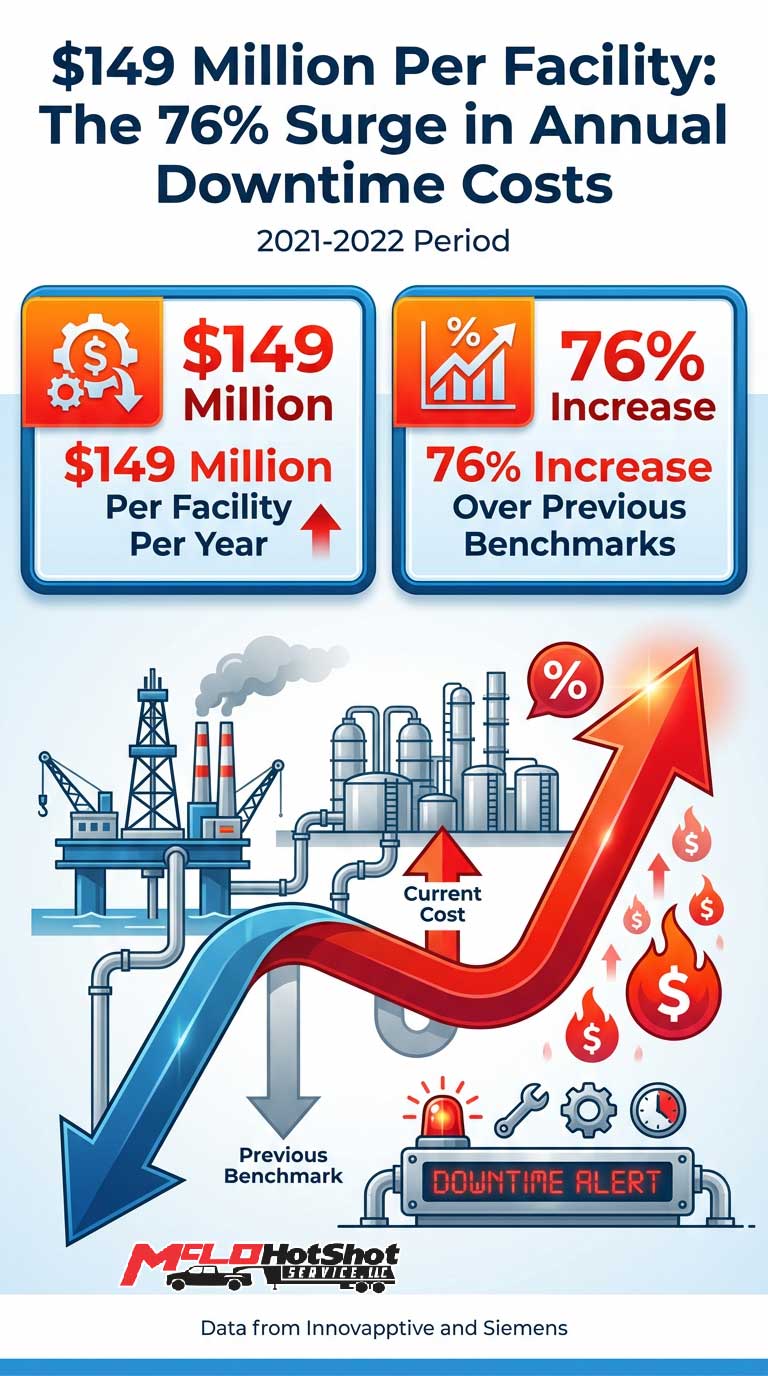
Result: Data from Innovapptive and Siemens indicates that unplanned downtime costs in the oil and gas industry reached approximately $149 million per facility per year during the 2021–2022 period studied — a 76% increase over previous benchmarks.
Context: A 76% surge in any major cost category would attract attention in any industry. In oil and gas, where capital discipline has become the watchword — especially in the Permian Basin, where operators are already tightening budgets due to mid-$60s WTI pricing — a cost increase of this magnitude demands operational countermeasures. Investments in transportation logistics that can shave hours off emergency response times represent one of the few high-ROI levers operations teams can pull without major capital expenditure.
5. The Permian Basin Produces 45% of America’s Oil
Background: Discussions about oilfield delivery logistics can sound localized — a trucking problem in West Texas. But the scale of what the Permian Basin contributes to national energy supply reframes the conversation entirely.
Result: According to the U.S. Energy Information Administration and the Railroad Commission of Texas, the Permian Basin accounts for approximately 45% of total U.S. oil production, generating over 6 million barrels per day. The basin spans more than 86,000 square miles across 55 counties in West Texas and southeastern New Mexico.
Context: This means that delivery delays in the Permian Basin are not a regional inconvenience. They are a variable in national energy output. When a critical pump component sits in a warehouse because transportation couldn’t be arranged quickly enough, the impact doesn’t stop at one well site. It contributes to the cumulative production shortfalls that influence U.S. supply figures, pricing, and energy security. Companies operating in Midland, Odessa, Big Spring, and Carlsbad are not just managing local operations — they are supporting a production base that underpins nearly half of the country’s oil output.
6. 10 Counties, 93% of U.S. Oil Production Growth
Background: While the Permian Basin is large, its production growth is highly concentrated in a small number of counties. This geographic concentration has significant implications for logistics.
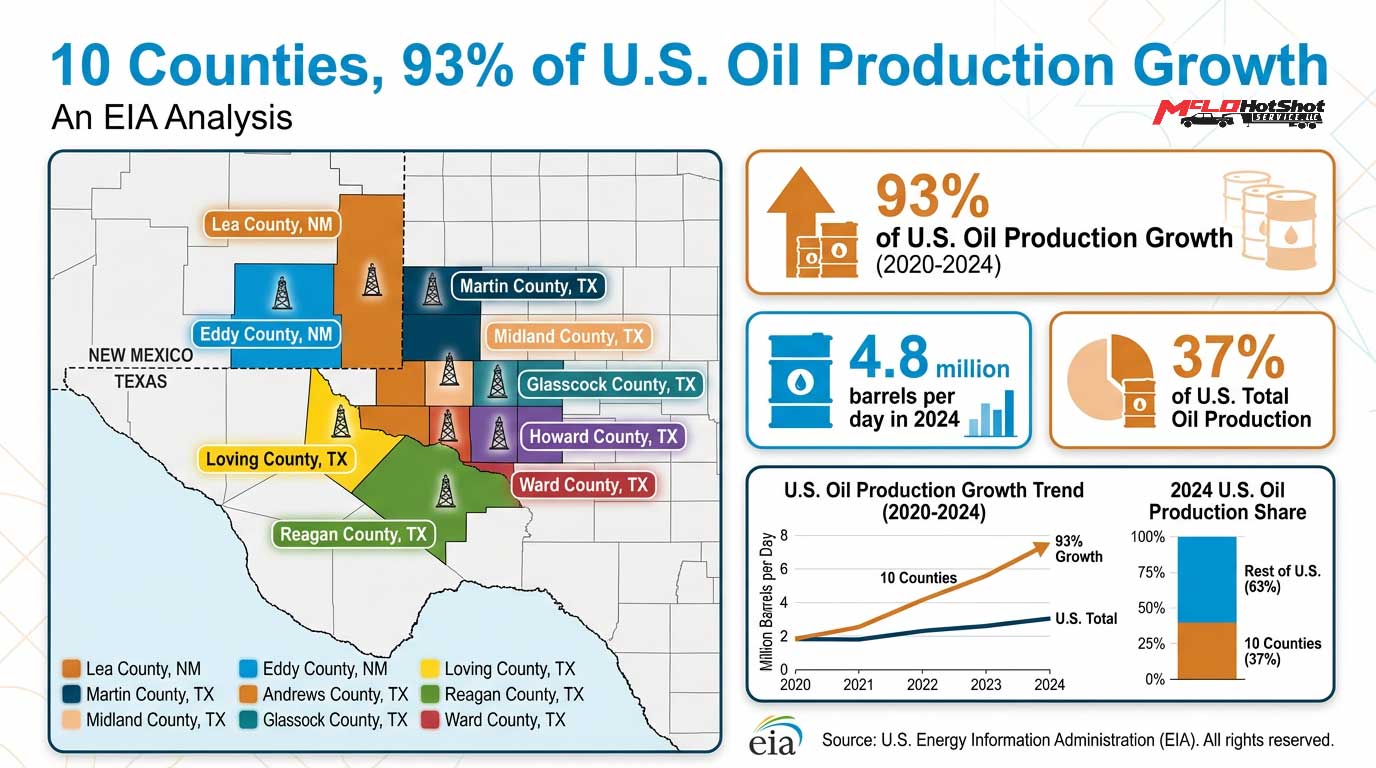
Result: An EIA analysis found that just 10 counties within the Permian Basin — including Lea and Eddy counties in New Mexico, and Martin, Midland, Andrews, Glasscock, Howard, Loving, Reagan, and Ward counties in Texas — accounted for 93% of all U.S. oil production growth between 2020 and 2024. Together, these counties produced 4.8 million barrels per day in 2024, representing 37% of the U.S. total.
Context: This concentration means that the logistics infrastructure serving these 10 counties — the hotshot carriers, the freight routes, the local dispatch networks — carries a disproportionate share of responsibility for U.S. energy production growth. A specialized hauling service operating in these corridors is not serving a niche market; it is supporting the geography that drives nearly all of the country’s production gains.
7. Fewer Rigs, More Maintenance: The Permian’s Logistics Paradox
Background: A common assumption is that when drilling activity declines, the need for oilfield logistics declines with it. Fewer rigs should mean fewer loads to haul. The data suggests a more nuanced picture.
Result: According to Baker Hughes’ weekly rig count data, the Permian Basin’s active rig count has fallen approximately 6.5% year-over-year, with 544 rigs active as of late 2025 — down 38 from the prior year. Yet production continues to reach record or near-record levels, driven by longer laterals, optimized completions, and greater per-rig productivity.
Context: What this means for logistics is counterintuitive. Fewer rigs does not mean less demand for delivery services. It means the demand is shifting. When new-well drilling slows, the massive base of existing production — over 6 million barrels per day — still requires constant maintenance, workover, artificial lift upgrades, and flow assurance. These activities generate a steady stream of oilfield equipment transport needs that are less predictable and more urgent than the equipment moves associated with planned new drilling. The International Energy Agency’s 2025 report underscores this: nearly 90% of annual upstream oil and gas investment globally now goes to offsetting production declines — not to expansion. The equipment being moved is overwhelmingly for keeping existing wells alive.
8. Equipment Moves Down 19% — But Production Doesn’t Stop
Background: While the rig count decline is well documented, the impact on actual freight and equipment movement in the Permian Basin has received less attention.
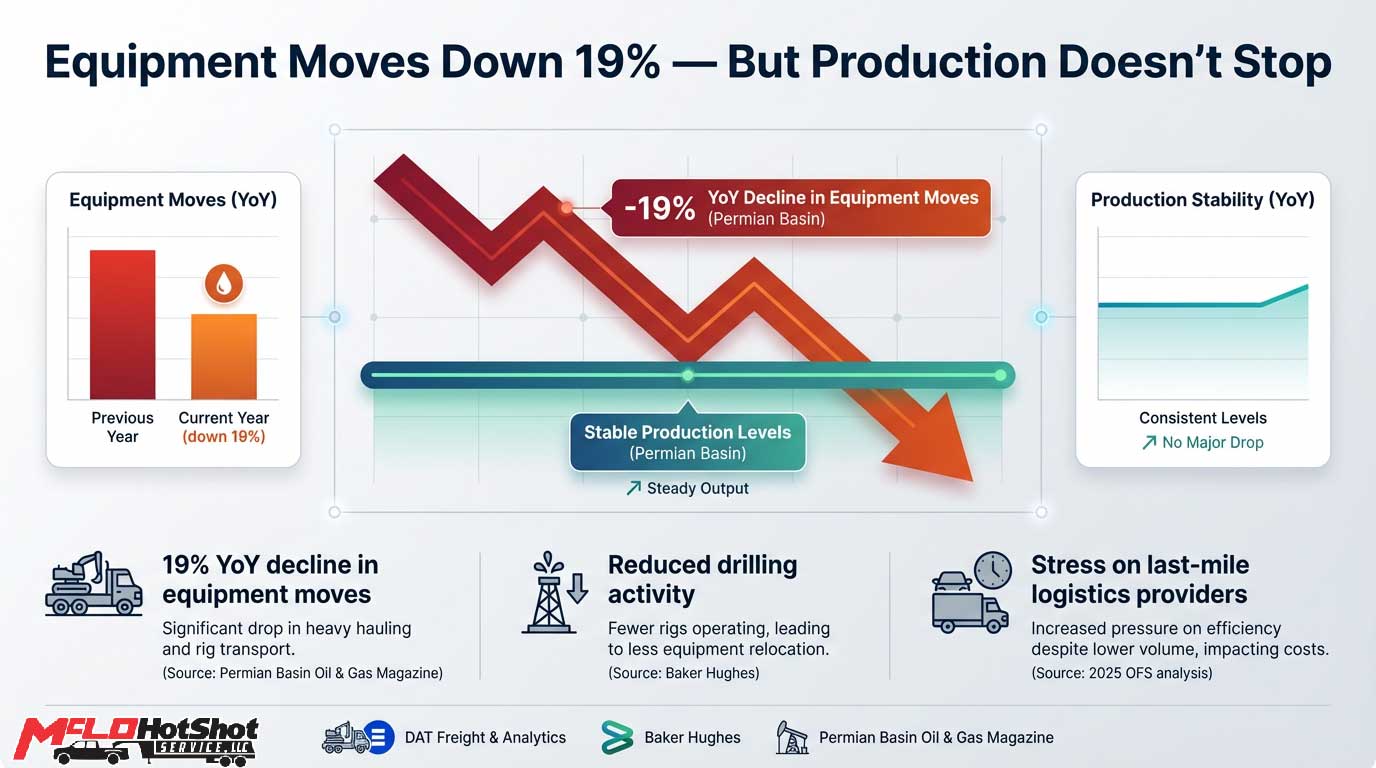
Result: DAT Freight & Analytics reported that equipment moves in the Permian Basin have declined 19% year-over-year, consistent with Baker Hughes data showing reduced drilling activity. The Permian Basin Oil and Gas Magazine’s 2025 OFS analysis similarly flagged stress on “last-mile logistics providers” as operators tightened budgets.
Context: A 19% decline in equipment moves creates a challenging environment for logistics providers. Some carriers have exited the market or reduced capacity. But the equipment that IS moving tends to be more time-critical — replacement parts for failing wells, emergency components for unplanned shutdowns, workover equipment needed to restore production. The loads are fewer but more urgent. And with fewer carriers available to handle them, the operators who have reliable, on-call emergency transportation partners have a meaningful advantage over those scrambling to find available trucks when something breaks.
9. When a Part Takes 12 Months to Arrive, Last-Mile Speed Is Everything
Background: The time between ordering a replacement oilfield component and receiving it at a well site involves two very different phases: sourcing lead time and delivery time. Most of the conversation focuses on the first phase. The second phase — the last mile — often receives less attention.
Result: According to Toptech Systems, a hardware provider with over 35 years in the oil and gas industry, standard oilfield parts now carry lead times of 12 to 30 weeks. Legacy or specialized components can take up to 12 months to source and manufacture.
Context: When a part takes 6 months or more to arrive at a distribution point, the delivery from that point to the well site becomes the only remaining variable the operations team can control. A 12-hour difference in last-mile delivery can mean the difference between a well restarting today or sitting idle until tomorrow. At nearly $500,000 per hour of downtime, those hours matter enormously. This is where hotshot trucking rates justify themselves — not as a premium freight option, but as the final, controllable step in a months-long sourcing process.
10. 39 Downtime Events in a Single Month: The Daily Reality of NPT
Background: Industry-wide downtime statistics, while useful, can feel abstract. A closer look at facility-level data makes the problem more tangible.
Result: A case documented by Toptech Systems found that a single mid-sized oil and gas facility experienced 39 non-productive time (NPT) events in a single month. Each event lasted an average of 3.32 hours. Over half were caused by mechanical failures. The cost per incident exceeded $400,000.
Context: Thirty-nine events in 30 days is more than one per day. This is not a once-in-a-while emergency — it is the daily operating reality for many oilfield facilities. Each of those 39 events is a moment where the clock starts at $500,000 per hour and someone needs a part, a tool, or a piece of equipment delivered as fast as possible. At that frequency, having a reliable oilfield equipment transport partner on speed dial is not a luxury. It is an operational necessity. Over the course of a year, upstream companies face an average of 27 days of unplanned downtime, with associated costs reaching $38 million.
11. 60,000 Missing Drivers and a Retiring Workforce
Background: Even if oilfield operators fully recognize the value of fast delivery, the ability to execute depends on having drivers and logistics professionals available to do the work. Both pools are shrinking.
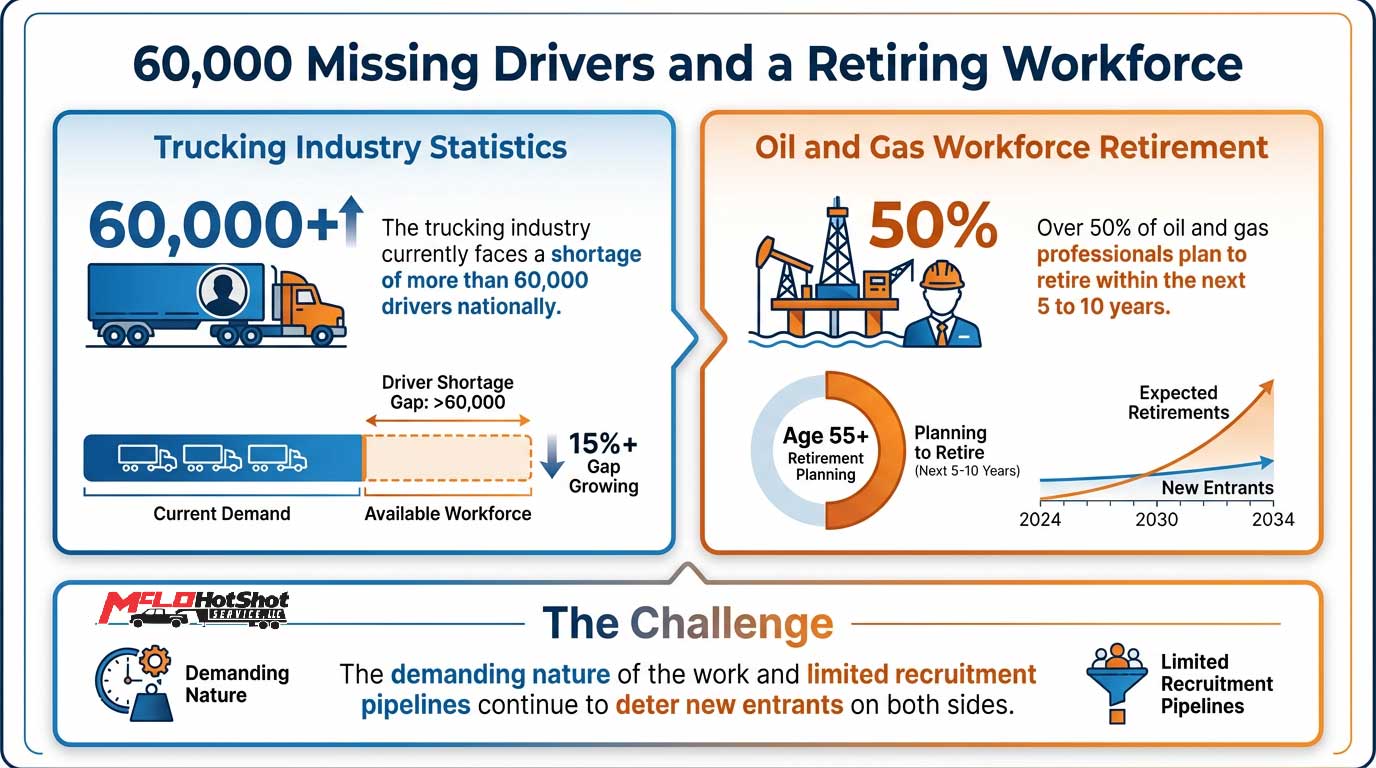
Result: The trucking industry currently faces a shortage of more than 60,000 drivers nationally. Simultaneously, a study by Mercer found that over 50% of oil and gas professionals plan to retire within the next 5 to 10 years. The demanding nature of the work and limited recruitment pipelines continue to deter new entrants on both sides.
Context: This dual workforce challenge creates a compounding effect. Fewer drivers means longer wait times for dispatched loads, reduced carrier availability during peak demand, and upward pressure on hotshot trucking rates. Fewer experienced oilfield workers means less institutional knowledge about which equipment is most critical, which failures are most likely, and how to respond efficiently when something goes wrong. The companies that will navigate this best are those building long-term relationships with reliable transportation logistics partners — rather than relying on spot-market scrambles when emergencies hit.
Conclusion
The data paints a clear picture: in the Permian Basin, delivery speed is not a logistics detail. It is a production variable.
When downtime costs $500,000 per hour and 92% of shutdowns are unplanned, the difference between a 2-hour delivery and a 12-hour delivery is measured in millions — not thousands.
This report draws on publicly available data from the U.S. Energy Information Administration, the International Energy Agency, Baker Hughes, Siemens, DAT Freight & Analytics, and other sources cited throughout. We thank these organizations for making their research accessible.
McLo Hotshot Service LLC has provided emergency transportation and oilfield equipment delivery across the Permian Basin since 2013. To learn more about our services or discuss your delivery needs, contact us here.
Now we’d like to hear from you.
If you manage oilfield operations in the Permian Basin — has a delayed equipment delivery ever cost your operation real downtime? What’s the most time-critical piece of equipment you’ve had to get to a well site on short notice?